
Apple Spanish Activities: Fun, Hands-On Learning for Bilingual Kids
Apple Spanish activities are simple ways to incorporate Spanish learning with a simple theme. In this lesson, you’ll see how to use the apple theme to add math, literacy, and even science into daily activities.
As a teaching tool, apples are the first signs of fall and harvest time. They are colorful, familiar, and full of learning possibilities. From counting seeds to exploring science experiments, apples open the door to rich, meaningful Spanish learning for bilingual learners.
Whether you are a bilingual educator building fall centers or a parent looking for a fun weekend activity, these apple-themed ideas will make Spanish feel like a natural, joyful part of your child’s day. Let’s dig in!
Getting Started with Apple Spanish Activities: Quick Prep List
The best part? You do not need much. Here is what to gather before you begin:
- Apples in three colors: rojo (red), verde (green), amarillo (yellow)
- Or, you can use models of apples in these colors
- Paper, markers, glue, and scissors
- Number cards 1–10
- Cups, lemon juice, salt, and water
- A balance scale or kitchen scale
- A magnifying glass (lupa)
- Simple labels written in Spanish
That’s it! Now you are ready for a full day of bilingual apple adventures for your apple Spanish activities.
Core Spanish Words to Use All Day
Sprinkle these words into every activity. Repetition builds confidence! Use the table below to create anchor charts, display words on your board, or use them in your word pocket chart.
| ENGLISH | SPANISH |
|---|---|
| apple | manzana |
| peel | piel |
| flesh | pulpa |
| seeds | semillas |
| stem | tallo |
| leaf | hoja |
| sweet | dulce |
| tart | ácida |
| crisp | crujiente |
| red | rojo |
| green | verde |
| yellow | amarillo |
| more | más |
| less | menos |
| large | grande |
| medium | mediano |
| small | pequeño |
Post these on a word wall or tape them to your apple display. Little eyes will start reading them before you know it!
Math and Counting
Apples and math go together like, well, apples and cinnamon! Here are easy ways to build number sense in Spanish:
- Count apples from 1–10 and say each number in Spanish
- Place apples individually or in frames and ask, “¿Hay más o menos?”
- Build color patterns (AB, AAB, ABC) using red, green, and yellow apples
- Add and subtract with apple stickers. Practice saying “sumas y restas”
- Compare weights on a scale and use “más pesado / más ligero”
- Graph a taste test using three flavors: (sweet) dulce, (tart) ácida, (crisp) crujiente
- Explore fractions by slicing apples into halves and quarters
Apple Spanish Activity for Math Learning: Apple Taste Test Graph
- This activity combines math, vocabulary, and a little delicious fun:
- Slice three types of apples
- Label cups: sweet (dulce), tart (ácida), crisp (crujiente)
- Let kids taste, vote, and tally results
Build a simple bar graph together
- Ask: Which flavor has the most votes? (más votos) Which has less? (menos)
- Use the sentence frame: “Yo prefiero ____ porque ____.”
- Kids love voting. And they love snacks even more!
Shapes and Geometry
Who knew apples were hiding geometry lessons inside? Here is how to explore shapes in Spanish:
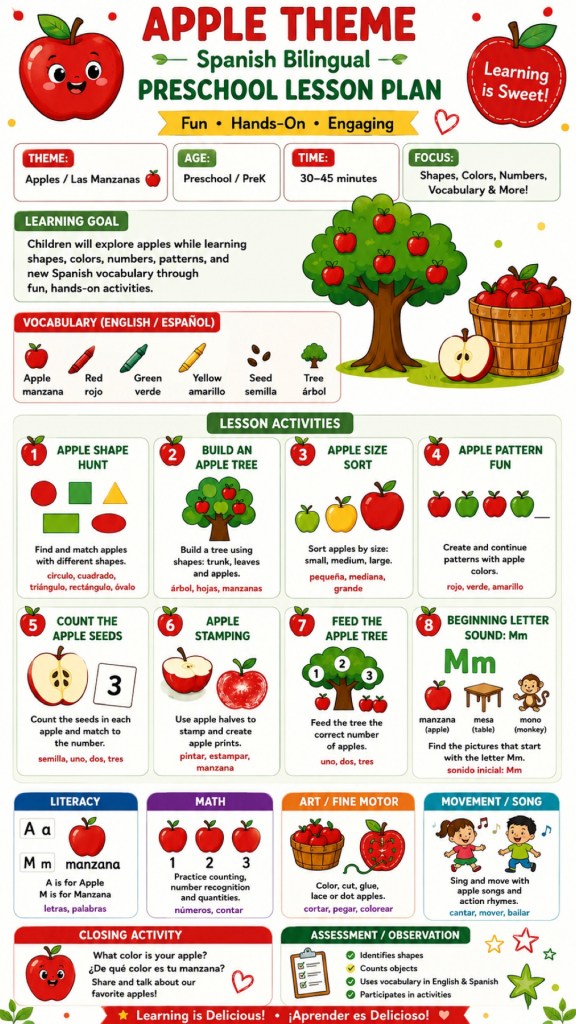
- Go on a shape hunt. Find circles, ovals, stars, and rectangles
- Cut an apple horizontally and reveal the star (estrella) in the seeds. Kids are always amazed!
- Build an apple tree using shapes. Trunk = rectangle (rectángulo). Leaves = ovals (óvalos). Apples = circles (círculos)
- Create apples using tangram pieces and name each shape in Spanish
- Sort apples by shape, color, and size. Practice big = grande, medium = mediana, small = pequeña
This is a wonderful moment to pause and let children discover. The star inside the apple never gets old!

Art and Sensory Play for Apple Spanish Activities
Creative play builds vocabulary in the most natural way. Try these hands-on art ideas:
Apple stamping – Dip apple halves in paint and stamp colorful patterns
Torn-paper collage – Build an apple and label each part in Spanish
Cinnamon sensory bin – Add scoops, number cards, and Spanish labels
Play-dough apples – Roll, shape, and count seeds. Build numbers, too!
Nature collage – Use real leaves and stems. Say leaf = hoja and stem = tallo as you create
Sensory play is not just fun. It is powerful language learning in action. Children connect words to their fives senses in ways that stick!
STEM and Science
Ready to put on your science hats? Apples are a goldmine for hands-on STEM exploration in Spanish:
- Parts of the apple – Label peel = piel, flesh = pulpa, seeds= semillas, stem = tallo, leaf = hoja on a diagram
- Apple life cycle in Spanish – Explore seed → sprout → tree → flower → apple
- Sink or float test – Predict, test, and record. Ask: “¿Float (Flota) o se sink (hunde)?”
- Flower to fruit connection – Name parts: petals = pétalos, pollen = polen
- Observation station – Use a magnifying glass and draw detailed sketches
Try This for Enrichment: Oxidation Experiment
This one always sparks big conversations about change:
- Cut four apple slices
- Place each in a labeled cup: air, water, salt water, lemon juice
- Wait 10–30 minutes and observe browning
- Ask: Which slice changed colors or showed browning? Why?
- Use vocabulary: change = cambio, fast = rápido, slow = lento
Watch little scientists get curious and start asking questions in two languages! Use a graphic organizer to help your bilingual learners jot down or draw their observations.


Literacy and Phonics
Apples are a perfect springboard for phonics and early literacy in Spanish. Here are simple, effective ideas:
Focus on letter M – Practice ma–me–mi–mo–mu using the word “manzana”
Picture-word cards – Match apple parts to their Spanish labels
Syllable clap – Clap man–za–na together (3 claps!)
Sentence frames – “Yo veo una manzana roja.” / “I see a red apple.”
Rhyme time – Try the pair “roja/hoja” and add new ones
Writing prompt – “My apple is… (color, size, taste).”
Pocket chart fun – Mix up sentence cards and let kids put them back in order
Phonics in Spanish does not have to be complicated. Manzana does all the heavy lifting!
Reading Corner as part of your Apple Spanish Activities
Cozy up with apples and books! Here are ways to build comprehension and vocabulary:
- Read a nonfiction apple book. Point to parts as you read
- Read an orchard story and act out picking apples
- Use sequence cards. Retell the apple life cycle from seed to fruit
- Go on a vocabulary hunt. Find words like stem, seeds, and peel in the text
- Draw and label one new fact after reading
- Partner share: “I learned…” / “Aprendí…”
Reading and vocabulary go hand in hand. The more children hear and see words in context, the more confident they become.
Cross-Curricular Connections
One of the most beautiful things about apple activities is how naturally they connect across subjects:
Math + taste test = tallies, graphs, and number sense
Science + vocabulary = labeled diagrams in Spanish
Art + geometry = shape trees with Spanish names
Writing + science = explaining oxidation results in words for enrichment or more advanced learners
When children learn Spanish through meaningful content, language becomes a tool rather than a task. That is bilingual education at its best!
Differentiation Tips
Every child is on their own unique journey. Here is how to meet them where they are:
Pre-K – Use numbers 1–5. Big visuals. Simple hands-on steps
K–1 – Use numbers 1–10 and 11-20. Picture graphs. Short sentence frames
2nd–3rd grade – Add fractions, data analysis, and full Spanish labels
Multilingual learners – Use gestures, real apples, and sentence frames throughout
Quick Assessment Ideas
Check for understanding without the stress:
Exit ticket – Draw and label two apple parts in Spanish
Math check – Solve three apple facts (2+1, 5–2)
Science note – Write one result from the oxidation experiment
Family Connection
Learning does not stop at the classroom door! Here are simple ways to extend apple learning at home:
- Home tasting – Try two apple types. Vote and graph results together
- Word hunt – Find the letter M in labels, books, or food packaging
- Nature walk – Spot trees and leaves. Use “hoja” and “tallo”
- Simple recipe – Make apple slices with cinnamon. Describe the taste in Spanish!
When families join the learning journey, language grows twice as fast. Share these ideas with your families and watch the magic happen!
Time-Saving Tips for Busy Educators
Time is precious when you’re trying to navigate lesson plans and activities. Here are a few shortcuts:
- Pre-cut Spanish labels for apple parts before the lesson
- Reuse graph templates for other food-themed units
- Keep a “science tray” stocked with cups and spoons
- Laminate number cards for repeated center use
Ready to Get Started?
Apples truly are a teacher’s best friend. With one simple fruit, you can explore math, science, art, literacy, and Spanish vocabulary all in one sweet, crunchy lesson. Whether you are building a full apple unit or just adding a fun Friday activity, these ideas are here for you every step of the way.
Learning Spanish should feel like an adventure, not a chore. And with apples in hand, you are already on your way!
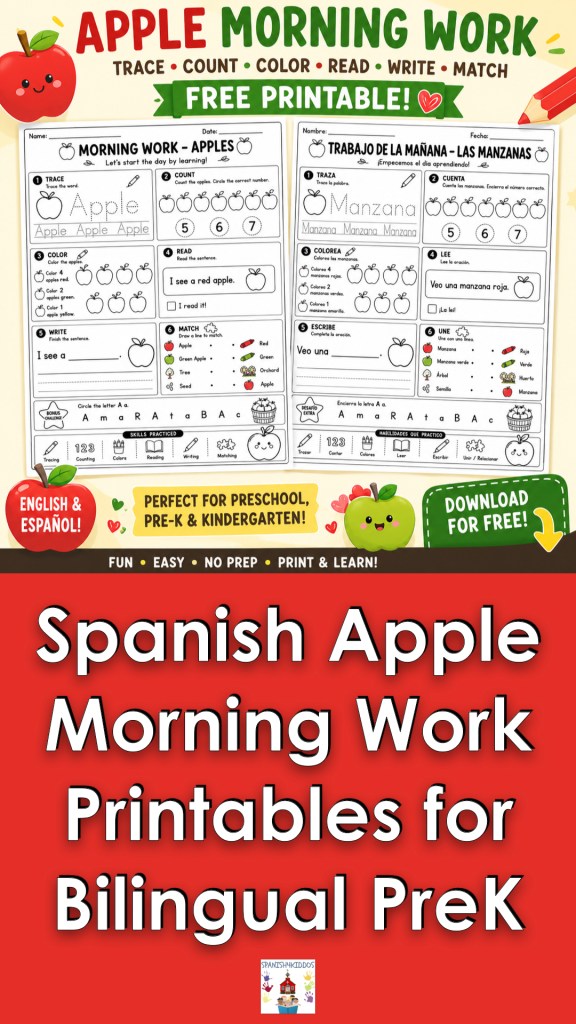
Looking for apple or fall theme printables, workbooks, morning work or informational texts in English and Spanish? Visit the Spanish4Kiddos store that help make your apple activities even sweeter. Or, request a sample here.


Get Your Free Spanish Sight Words Workbook
Subscribe to our Spanish Sight Words newsletter and receive a free workbook. The booklet consists of writing practice, classroom labels, and activities.

Spanish Nursery Rhymes for Preschoolers
Subscribe and receive your Free Spanish Nursery Rhymes for Preschoolers Workbook.
