Bilingual Language Lesson Comparison and Contrast: Fairy Tales and Informational Texts
One of the most effective ways to teach children critical thinking and text analysis is by guiding them to compare and contrast different types of texts. A great bilingual language lesson example of this is comparing fairy tales, like Cinderella, with informational texts, such as passages about castles in medieval times.
Both offer opportunities for learning, but in very different ways: fairy tales spark imagination and moral reasoning, while informational texts build factual knowledge and analytical skills.
In this bilingual language lesson plan, you’ll use creative teaching strategies to teach about comparison and contrast. Then, you can incorporate various activities to reinforce your students’ understanding.
Plus, you’ll find online resources, including tools like Padlet for interactive Venn diagrams, where students can organize their findings, as well as free printables available at Spanish4Kiddos.
Bilingual Language Lesson Key Ideas
Comparing and contrasting fairy tales and informational texts help students:
- Develop critical thinking by identifying similarities and differences.
- Understand the purpose, tone, and structure of various text types.
- Learn how fiction and nonfiction address related themes, such as castles or cultural traditions.
For example, the Cinderella story might portray a magical ballroom in a grand castle where dreams come true, while an informational article might detail facts about medieval castles’ architecture, history, and utilitarian function. Teaching children to not only recognize these differences but also appreciate their overlap is incredibly valuable for literacy development.
Engagement Techniques for your Bilingual Language Lesson
Create a list of “true or false” statements, mixing facts related to Cinderella and castles such as “Castles often hosted royal balls like in Cinderella”. Students must guess whether they are true or false. This method creates curiosity about both the fairy tale and nonfiction contexts.
- Begin the class by asking students to imagine they’re traveling back to medieval times.
- Describe a grand castle with ballrooms.
- Then, introduce Cinderella as a fictional perspective of that era and nonfiction texts as historical accounts.
Display images of Cinderella-like castles such as Neuschwanstein Castle, which inspired Disney’s Cinderella castle, alongside diagrams or photos of real medieval castles. Ask students, “What’s the story here? Why does this castle exist, and who lived here?” These teacher-led questions help set the stage for comparing fact and fiction.


Instructional Strategies to Teach Comparison and Contrast
Direct Text Analysis in your Bilingual Language Lesson
Side-by-Side Reading:
Provide students with excerpts from Cinderella and an informational passage about medieval castles. Have them use a split-page organizer to analyze differences and similarities:
- Purpose: Why was this text created?
- Audience: Who is it written for?
- Content: What do we learn about castles?
Example Organizer:
| FAIRY TALE (CINDERELLA) | INFORMATIONAL TEXT (CASTLES) | |
|---|---|---|
| Who is the intended audience? | general, entertainment for kids | people interested in history |
| Why was the text written? | to entertain, teach morals | to provide factual information |
| What perspective is presented? | fictional, magical, fantasy | objective, facts, historical |
Group Comparisons
Group Sorting Activity:
Provide students with mixed statements or sentences from both text types.
Examples:
- Fairy Tale: “The prince held a grand ball to find the mysterious young woman!”
- Nonfiction: “Castles often hosted formal events in ballrooms decorated with intricate designs.”
Students work in groups to sort statements into “fiction/fantasy” or “nonfiction/facts.”
Discuss as a class: What clues helped you sort the statements?
Jigsaw Activity:
Divide students into groups. Assign each group a focus:
- Group A: Analyze Cinderella (language, tone, purpose).
- Group B: Analyze informational text (facts, structure, purpose).
- Bring groups together to share findings and collaboratively compare the texts.
Additional Bilingual Language Lesson Teaching Techniques:
Here are tried-and-true strategies to help children grasp the key concepts of comparison and contrast:
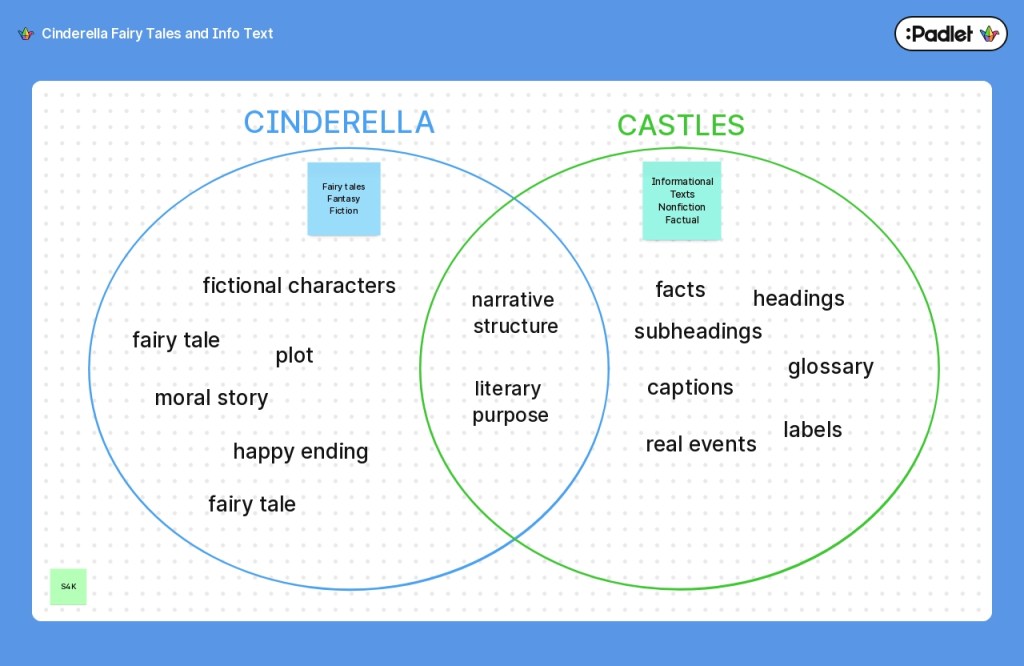
Interactive Venn Diagrams with Padlet
Use tools like Padlet to create a collaborative Venn diagram online. Students can post similarities (“Both talk about castles”) and differences (“Fairy tales have magical elements and nonfiction describes factual history”). This digital method allows for real-time collaboration, making it especially useful for group work or virtual classrooms. Or, you can use the FREE graphic organizers from Spanish4Kiddos.
Side-by-Side Reading
Provide kids with a short passage from Cinderella and a nonfiction article about medieval castles. Have them work individually or in groups to create a T-chart comparing elements like purpose, tone, and content. For example, students might note that fairy tales use imaginative language like “an enchanted castle,” whereas nonfiction texts offer factual descriptions, such as “a fortified structure used for protection.”
Rewrite a Scene
Encourage creativity by having students rewrite a magical scene from Cinderella as if it were nonfiction. For example, they might translate “The ball glittered with golden chandeliers and fairy godmother magic” into factual language, such as, “Royal balls were hosted in torch-lit castle halls, built with stones.”
Infographics and Visual Notes
Challenge students to design an infographic comparing Cinderella’s story to the reality of medieval castles. They can include categories such as castles’ purpose, design, and the social dynamics of the time period.
Why Use Resources from Spanish4Kiddos?
Spanish4Kiddos provides excellent free resources, such as printable Venn diagrams, graphic organizers, and writing templates, to enhance this lesson. Whether you’re teaching in Spanish, English, or bilingually, these tools are ready to use and designed to keep lessons fun and engaging.
For example, use the Spanish4Kiddos graphic organizer to help students structure their ideas clearly, or download a printable fairy-tale storyboard template for the creative writing extension. All resources are available for members of Spanish4Kiddos or you can browse for fairy tales and informational texts in the shop.
Summary
Teaching children to compare Cinderella as a fairy tale story to informational texts about castles bridges the worlds of imagination and reality, offering valuable insights while developing their critical thinking. By incorporating tools like Padlet Venn diagrams into your bilingual language lessons and resources from Spanish4Kiddos, you can make these lessons both interactive and fun for kids.
Whether you’re an educator, parent, or homeschooler, this simple comparison activity can captivate students’ attention while helping them engage with both fiction and nonfiction texts.
Have you tried similar lessons with your class or kids? Share your thoughts and creative ideas in the comments below. Don’t forget to check out Spanish4Kiddos for free lesson materials to bring your ideas to life!
Comparing Fairy Tales and Informational Texts Bilingual Lesson Plan
This lesson is ideal for classrooms, homeschoolers, or even as an after-school activity.
CONTINUE READING AS A MEMBER:


Get Your Free Spanish Sight Words Workbook
Subscribe to our Spanish Sight Words newsletter and receive a free workbook. The booklet consists of writing practice, classroom labels, and activities.

Spanish Nursery Rhymes for Preschoolers
Subscribe and receive your Free Spanish Nursery Rhymes for Preschoolers Workbook.